



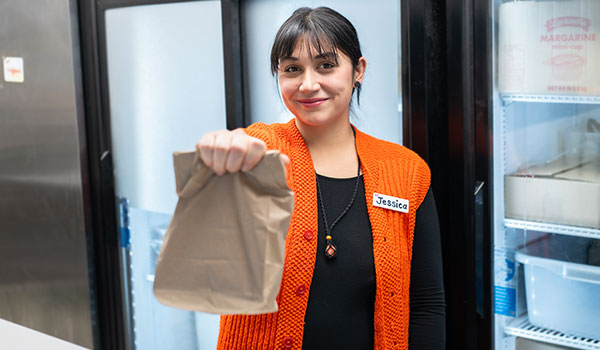
At the Welcome Centre Shelter for Women and Families, mealtimes are about far more than filling plates — they’re about creating stability, dignity, and hope. At the heart of this effort is the Centre’s Food Service Program, where a small but mighty team works tirelessly to feed over 100 people every single day. And now, that team is taking its mission beyond the shelter walls with the launch of a new social enterprise.
“I make sure everyone in the shelter gets fed,” says Jessica, the shelter’s Food Service Program Coordinator. “It sounds simple, but it’s far from it.”
Every morning begins with opening the service window for breakfast. By midday, the team is packing lunches — some for children heading to school, others for clients going to work or vital appointments. Dinner follows a carefully crafted two-week rotating menu that’s both culturally sensitive and budget-conscious.
“We work with just $4.52 per person, per day,” Jessica explains. “That has to cover breakfast, lunch, and dinner — and sometimes more when we have overflow.”
Despite the tight budgets the shelter faces, the shelter’s kitchen is committed to honouring every client’s unique needs.
“Homelessness doesn’t look like one thing, so our menu shouldn’t either,” Jessica says. That means respecting religious and cultural dietary restrictions, offering choices, and making sure that dignity is always on the plate. “It’s not just about eating, it’s about preserving dignity.”
The kitchen also plays a role in educating the children staying within the shelter. Through the shelter’s kids’ programming, children learn about healthy eating through hands-on experience with local produce, oral hygiene, and even basic science. One hands-on lesson involves soaking eggs in soda to show the effects of sugar on calcium.
“It’s simple but memorable,” Jessica says. “And it’s a start to making better choices.”
This food-first approach doesn’t stop at the shelter’s door. The Welcome Centre has long been part of the local Food Bank Association, once operating a public food bank before pivoting to in-house services during COVID. Today, as women and families transition into permanent housing, they leave with a week’s worth of groceries — fresh milk, meat, and produce — to help ease the shift. Occasionally, food packages are provided to low-income individuals in the community who aren’t staying at the shelter but are still in need.
“Food insecurity isn’t limited to our walls,” Jessica says. “We do what we can.”
And now, what they can do is growing.
The Welcome Centre has launched its first food services social enterprise — an initiative that extends the care and quality of its kitchen to organizations across the region.
“It’s always been a dream to have a social enterprise,” Jessica says. “Not necessarily food, just something to generate stable funding for our donation-reliant programs — especially our children’s programming and harm reduction work.”
So far, the enterprise has provided nutritious meals for community partners like the Canadian Mental Health Association (CMHA) and Windsor Essex Community Health Centre (WECHC).
“These are like-minded organizations serving similar populations,” she says. “We understand the importance of quality, dignity, and nutrition — because we do it every day.”
Moving from shelter cooking to professional catering wasn’t without its challenges. One of the biggest? Learning to value their work. “We’re so used to stretching every penny,” Jessica admits. “Shifting to pricing that reflects the value of our food — and supports our services — was tough. But what we offer is unique. It deserves to be recognized.”
The team — nine people strong — is now preparing to expand, with a public catering menu set to launch later this year. The goal is simple: bring delicious, high-quality meals to the community while generating income that supports the Centre’s essential programs.
“We’ve created some amazing recipes. I hope people will think of us when they’re planning an event — every order directly supports women and families right here in Windsor.”
When asked how she measures success, Jessica doesn’t hesitate. “If we keep everyone fed and stay within budget, that’s success,” she says. “But more than that, it’s about giving people the tools to navigate food insecurity long after they leave. It’s about filling plates — and filling people with confidence.”
There’s one more thing she wants people to understand: feeding over 100 people a day isn’t just about logistics — it’s about respect. “Everyone eats differently. Every story is different. Feeding people well, with dignity, takes more than food. It takes intention.”
And at the Welcome Centre, every bite is made with just that.









You must be logged in to post a comment.